ALL-22
Tactical Football Simulator
Each player thinks for himself.
All 22 players read the play and react on their own. Here is how the game plays and how the league runs.
ALL-22
Tactical Football Simulator
Each player thinks for himself.
All 22 players read the play and react on their own. Here is how the game plays and how the league runs.
The Play Lab
Design any play.
Start from a blank field and pro rules. Line up in any formation, assign each player a job and run the play in the engine.

The timeline
Snap it before they're ready.
Go no-huddle and the defense is stuck in its personnel and short on time to disguise. Use a hard count to draw it offside, or run the play clock down to the last second. Tempo changes how the defense plays.

- One track per man. Stem, break and settle for the receivers; the drop and the reads for the quarterback.
- Diamonds at the breaks. Drag one and the route runs on the new time.
- Pre-snap lives here too. Motion and shifts sit left of the gold Snap line.
The Inspector
See what each player is thinking.
Each player makes decisions throughout the play. The corner reads the receiver's hips, the linebacker keys the guard, the quarterback works his progression, and each reacts to the others. The play is unscripted.
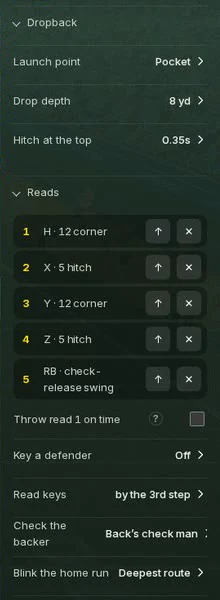
Quarterback
Drop depth, the hitch, his read order and the keys he checks.
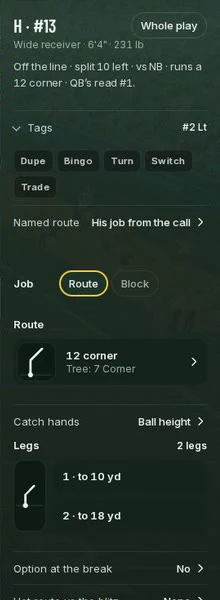
Receiver
His route from the tree, each leg, how he catches it, what he does vs the blitz.
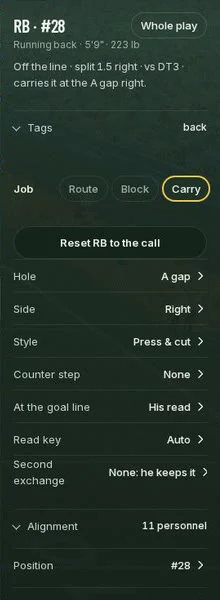
Running back
His hole and side, his running style and his read key.
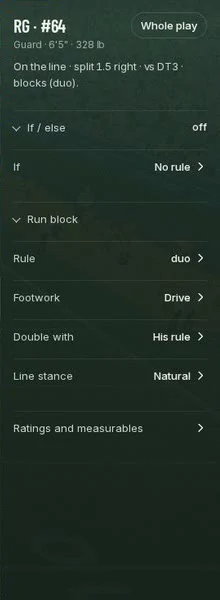
Guard
His run-block rule, his footwork, who he doubles with.
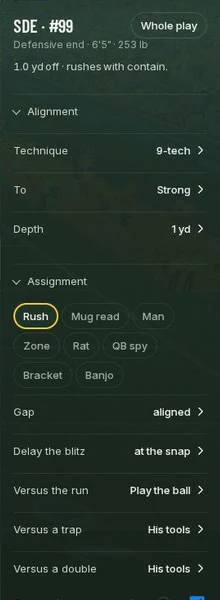
Defensive end
Technique, gap, when he goes, the tools he uses to beat a block.
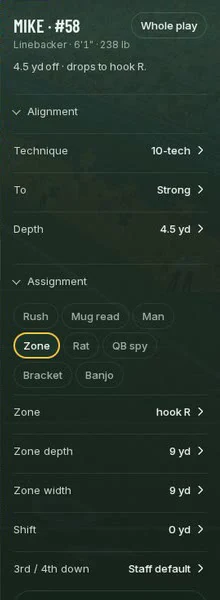
Linebacker
Where he aligns, his zone drop, how deep and wide, his key.
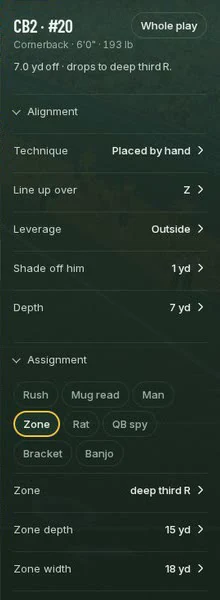
Corner
Who he lines up over, his leverage, his cushion, his eyes.
Coaching grammar
Talk football.
The terminology you hear on a broadcast works here. Tag a route, name a motion or set a split in coaching language, and your players run it as called.
- Dupe
- Bingo
- Switch
- Trade
- Swap
- Bunch
- Stack
- Zip
- Fling
- Hat
- Hinge
- Pre-snap. Front rules, tempo, snap counts. Kill it, flip it, check to a screen.
- Defense. Front, line movement, pressure, coverage, force and contain.
- Guard rails. Only what the rulebook forces: a legal formation, eligible numbers, motion and shift rules.
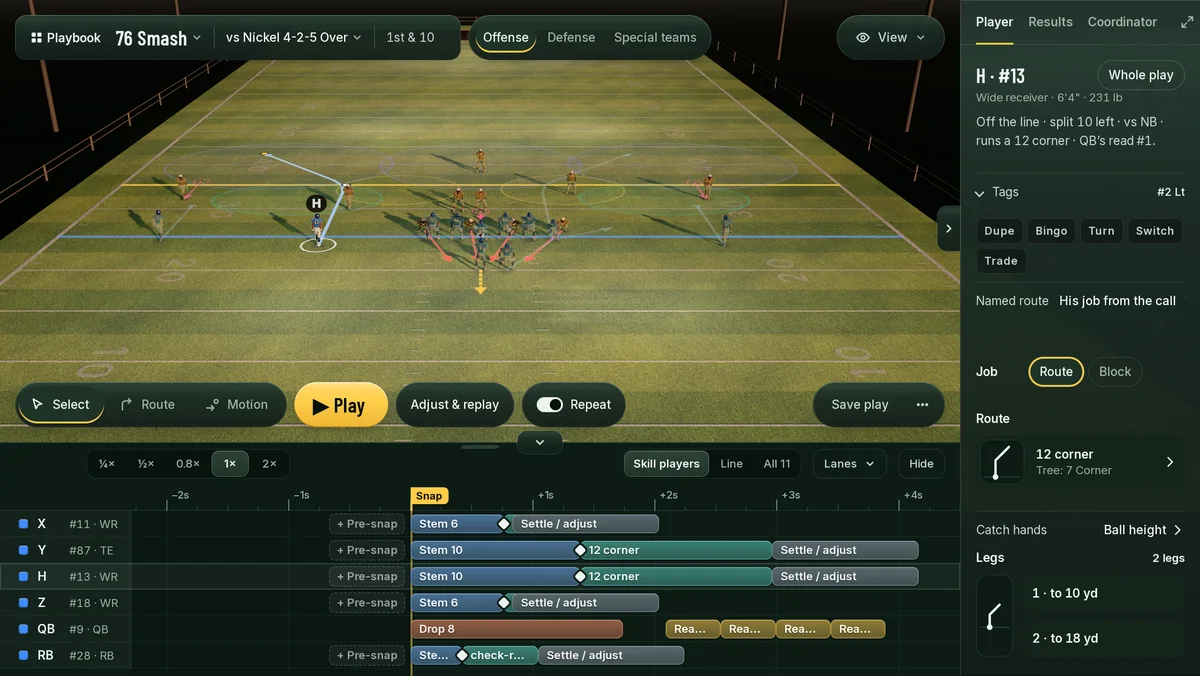
Live football
Watch it play out.
Results come from player reads, movement and collisions. The same call can produce different outcomes, and the replay shows why.
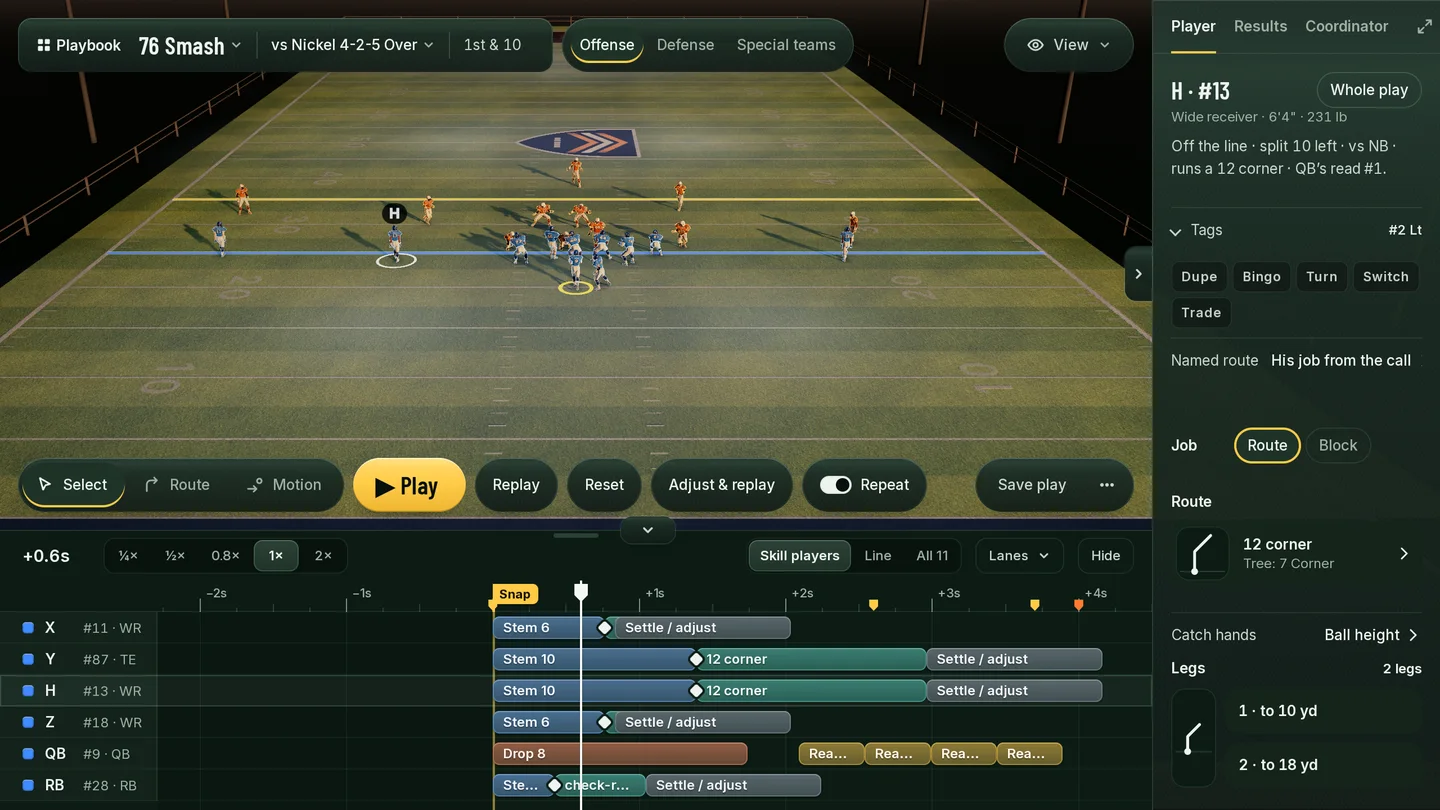
Adjust & replay
Change one thing. Run it again.
Same rep, same defense, one change. See what it did.
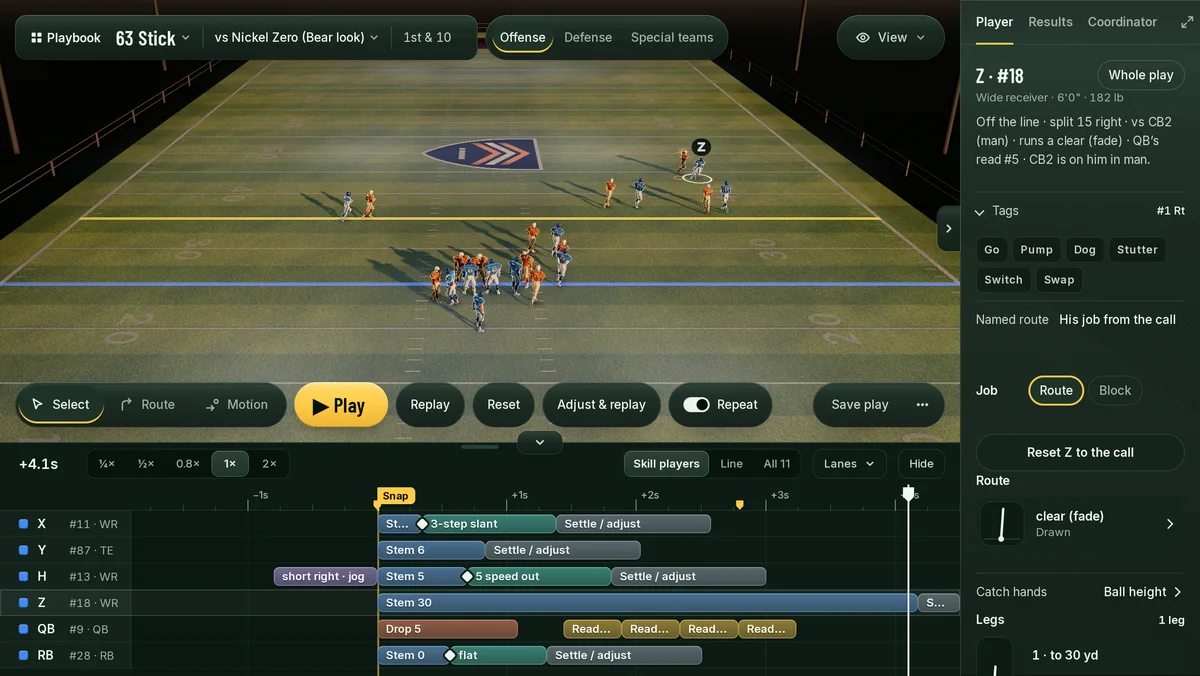
Before
Z clears out on a fade. The quarterback throws it to him and the corner breaks it up.
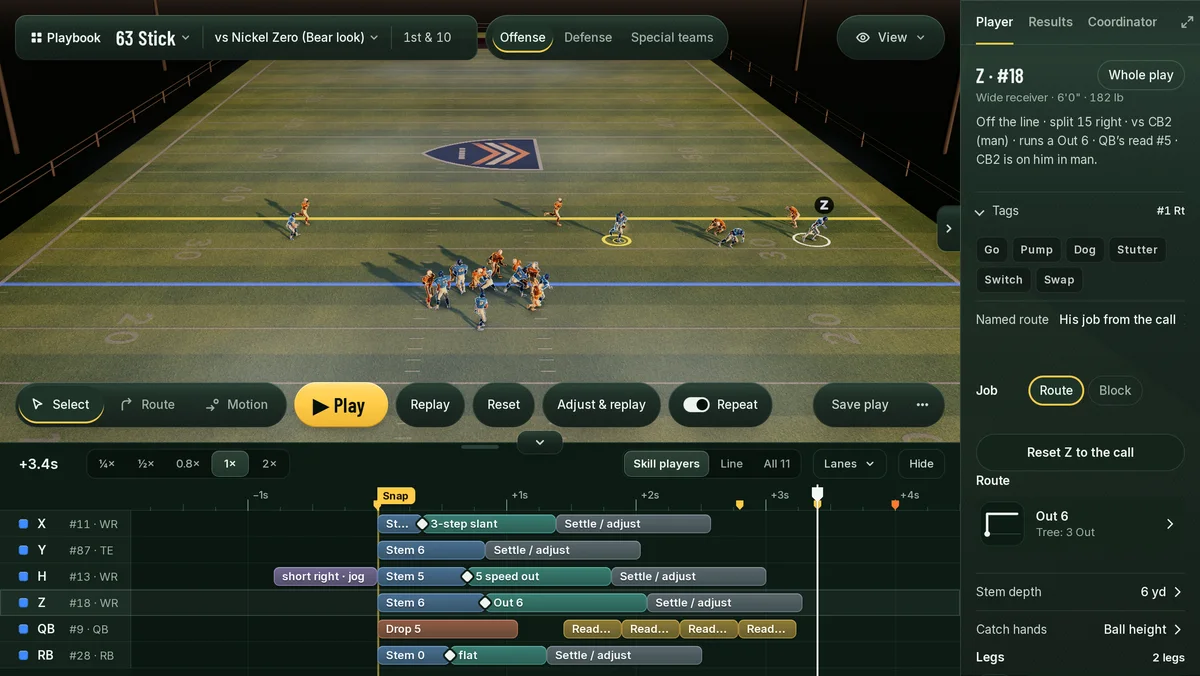
After
Z runs an out instead. The quarterback works to the tight end on the stick: caught, and upfield for a big gain.
In the Play Lab
The full Play Lab.
- PlaybooksOffense and defense books, plus sandbox books to break.
- Special teamsPunt, field goal and kickoff units, each one designable.
- Pre-snapFront rules, tempo, snap counts, disguise and walk-downs.
- DefenseCall it like a coordinator: front, movement, pressure, coverage.
- Plays start in the huddleWalk-up, break, set, snap.
- ThoughtsWhat all 22 are thinking as the play runs.
- TelemetryTrails, speed and separation on the 3D field.
- ResultsRun it many times. See what happened, and why.
The Play Lab
Design any play.
Start from a blank field and pro rules. Line up in any formation, assign each player a job and run the play in the engine.
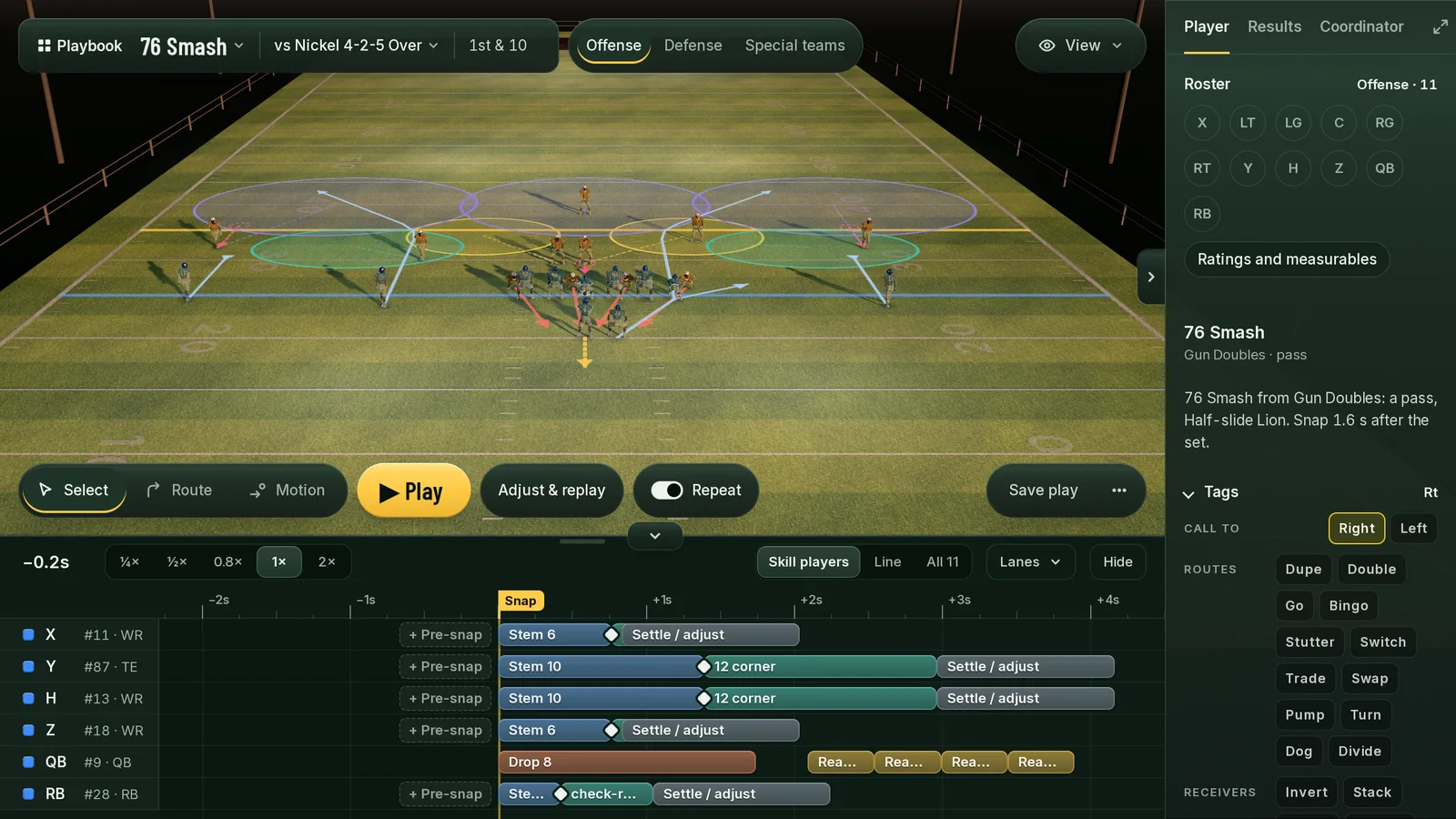
The timeline
Snap it before they're ready.
Go no-huddle and the defense is stuck in its personnel and short on time to disguise. Use a hard count to draw it offside, or run the play clock down to the last second. Tempo changes how the defense plays.
- One track per man.Stem, break and settle for the receivers; the drop and the reads for the quarterback.
- Diamonds at the breaks.Drag one and the route runs on the new time.
- Pre-snap lives here too.Motion and shifts sit left of the gold Snap line.
The Inspector
See what each player is thinking.
Each player makes decisions throughout the play. The corner reads the receiver's hips, the linebacker keys the guard, the quarterback works his progression, and each reacts to the others. The play is unscripted.
Quarterback
Drop depth, the hitch, his read order and the keys he checks.
Receiver
His route from the tree, each leg, how he catches it, what he does vs the blitz.
Running back
His hole and side, his running style and his read key.
Guard
His run-block rule, his footwork, who he doubles with.
Defensive end
Technique, gap, when he goes, the tools he uses to beat a block.
Linebacker
Where he aligns, his zone drop, how deep and wide, his key.
Corner
Who he lines up over, his leverage, his cushion, his eyes.
Coaching grammar
Talk football.
The terminology you hear on a broadcast works here. Tag a route, name a motion or set a split in coaching language, and your players run it as called.
- Dupe
- Bingo
- Switch
- Trade
- Swap
- Bunch
- Stack
- Zip
- Fling
- Hat
- Hinge
- Pre-snap. Front rules, tempo, snap counts. Kill it, flip it, check to a screen.
- Defense. Front, line movement, pressure, coverage, force and contain.
- Guard rails. Only what the rulebook forces: a legal formation, eligible numbers, motion and shift rules.
Live football
Watch it play out.
Results come from player reads, movement and collisions. The same call can produce different outcomes, and the replay shows why.
Adjust & replay
Change one thing. Run it again.
Same rep, same defense, one change. See what it did.
Before
Z clears out on a fade. The quarterback throws it to him and the corner breaks it up.
After
Z runs an out instead. The quarterback works to the tight end on the stick: caught, and upfield for a big gain.
In the Play Lab
The full Play Lab.
- PlaybooksOffense and defense books, plus sandbox books to break.
- Special teamsPunt, field goal and kickoff units, each one designable.
- Pre-snapFront rules, tempo, snap counts, disguise and walk-downs.
- DefenseCall it like a coordinator: front, movement, pressure, coverage.
- Plays start in the huddleWalk-up, break, set, snap.
- ThoughtsWhat all 22 are thinking as the play runs.
- TelemetryTrails, speed and separation on the 3D field.
- ResultsRun it many times. See what happened, and why.
Ratings
Ratings you can see.
Two players given the same assignment will play it differently. Vision, reaction time and execution all come from player ratings.
Feel the hit.
A big tackle carries his weight. A throw has to beat the wind. A hit answers to momentum. The players earn the result.
Player attributes
Each player has a height, weight and 40-yard dash time, and moves on the field at that speed.
Momentum
Mass and velocity decide each collision, from one-on-one blocks to multi-player piles.
Tackling
Each tackle is simulated as a collision. The angle and force of contact produce wraps, big hits, drag-downs or ankle tackles, and can force fumbles.
Line play
Linemen win each rep with individual moves, including punches, swims, rips, long arms and anchors, to create or stop pressure.
Ball flight
Throws lead the receiver and are affected by wind. Tipped passes stay live, and loose balls bounce the way a football does.
Quarterback vision
Higher-rated quarterbacks read more of the field. Safeties react to the quarterback's eyes and can be moved with a look-off.
Fatigue
Sprinting drains stamina over the course of a drive. A hurry-up offense can wear a defense down.
Weather and stadiums
Wind, rain, snow, playing surface, altitude and crowd noise all affect how a game plays.
The physics model
The equations behind the engineMomentum is mass multiplied by velocity. Bigger, faster players are harder to stop.
Impact force depends on both players' mass and their closing speed.
Momentum is conserved through contact, which determines whether a runner falls forward or is stopped.
Each player accelerates toward his own top speed at his own rate.
Air resistance slows the ball, so deep passes hang and wind alters their path.
Passes, punts and kicks rise and fall on a true arc, from the release to the hands.
How the league works
Run a 32-team league.
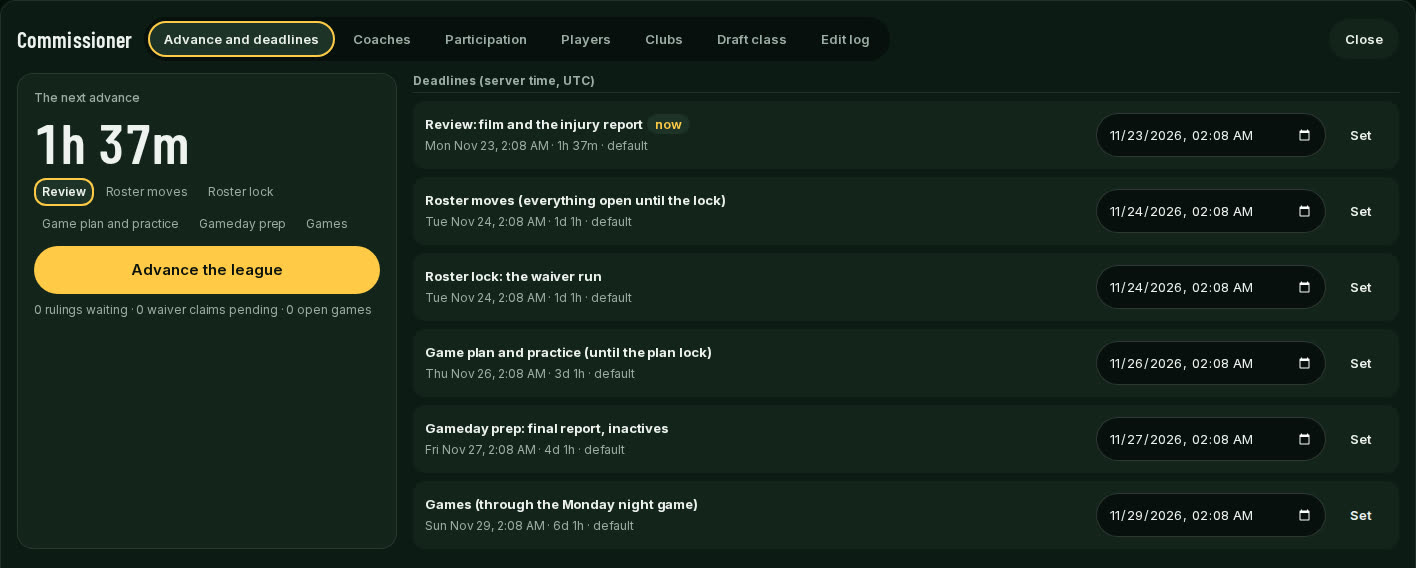
Scout, plan, play and review film each week. The whole league advances on a shared schedule.
- A commissioner runs itInvites coaches, sets the calendar and keeps the record, with changes logged for all to see.
- Coaches and AI GMsHuman coaches take clubs. AI general managers run the rest and trade actively.
- One league clockRoster lock, plan lock, kickoff. The week turns over for the whole league at once.
The week
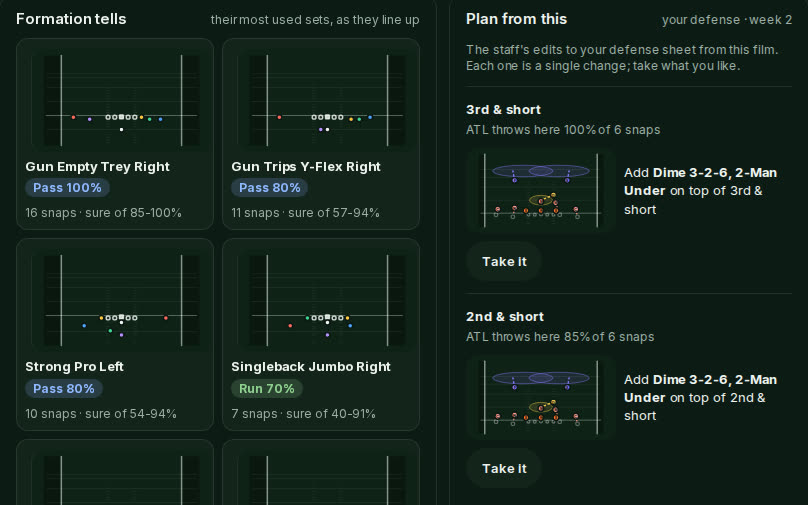
1Scout them
Your advance scout breaks down next week’s opponent. Take the counters you like.
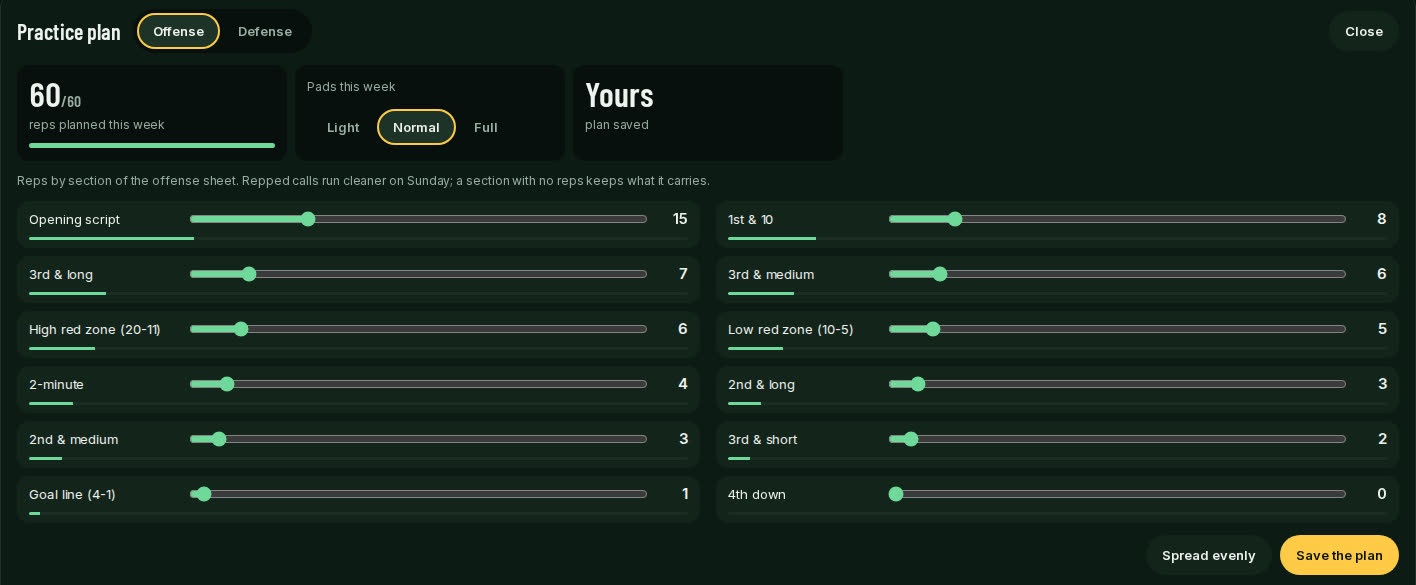
2Plan + practice
Build the call sheet and rep it in practice. Reps install the calls.
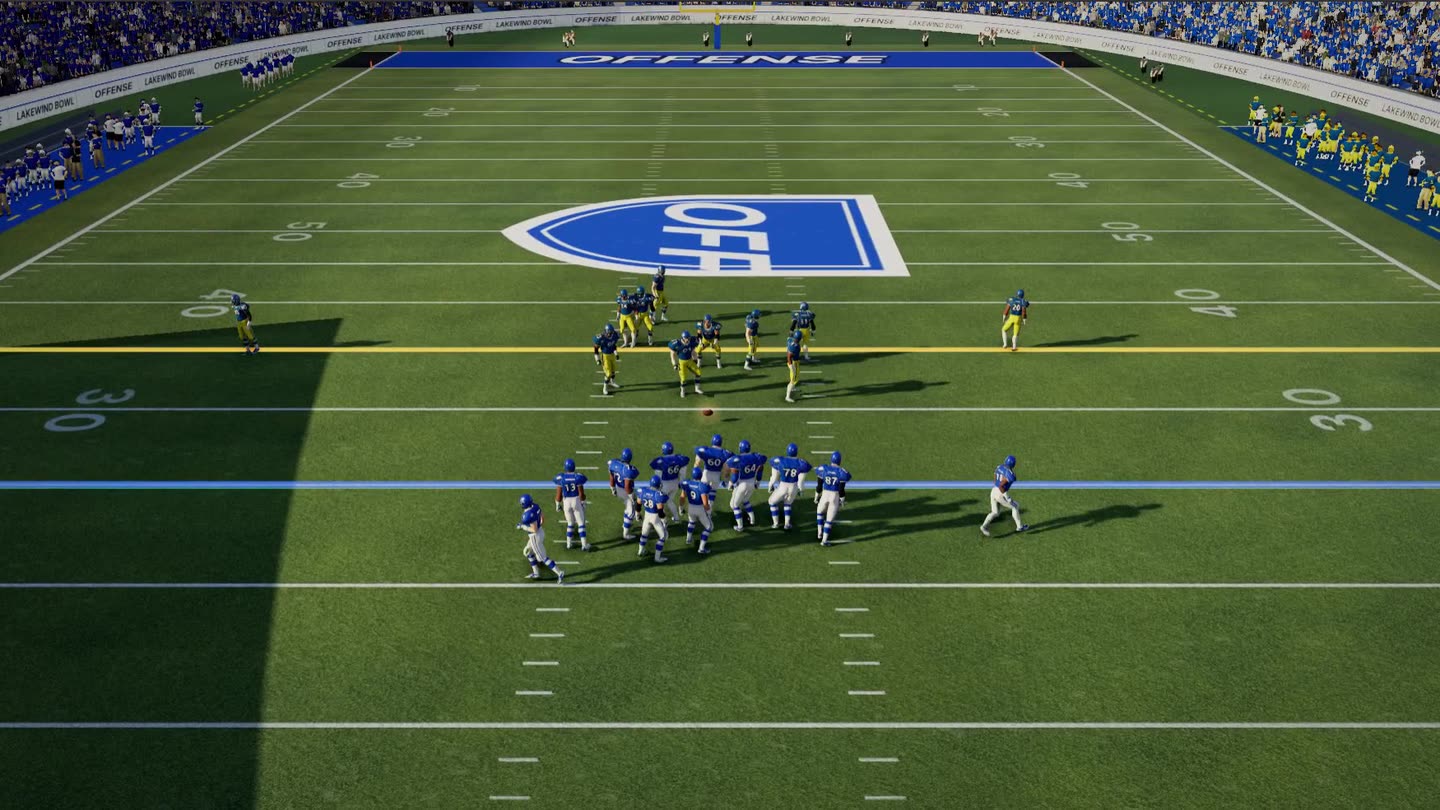
3Game day
Call it live from the sideline, or let your sheet run the game.
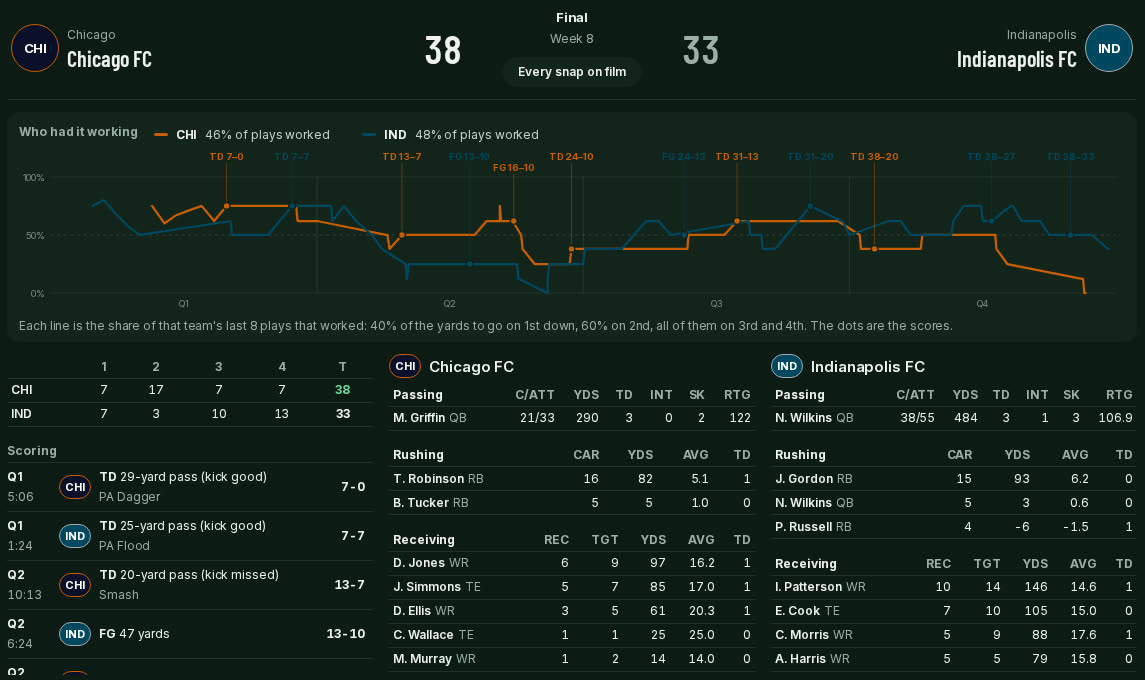
4Film + stats
The game goes in the book and the film goes in the room. Then next week starts.
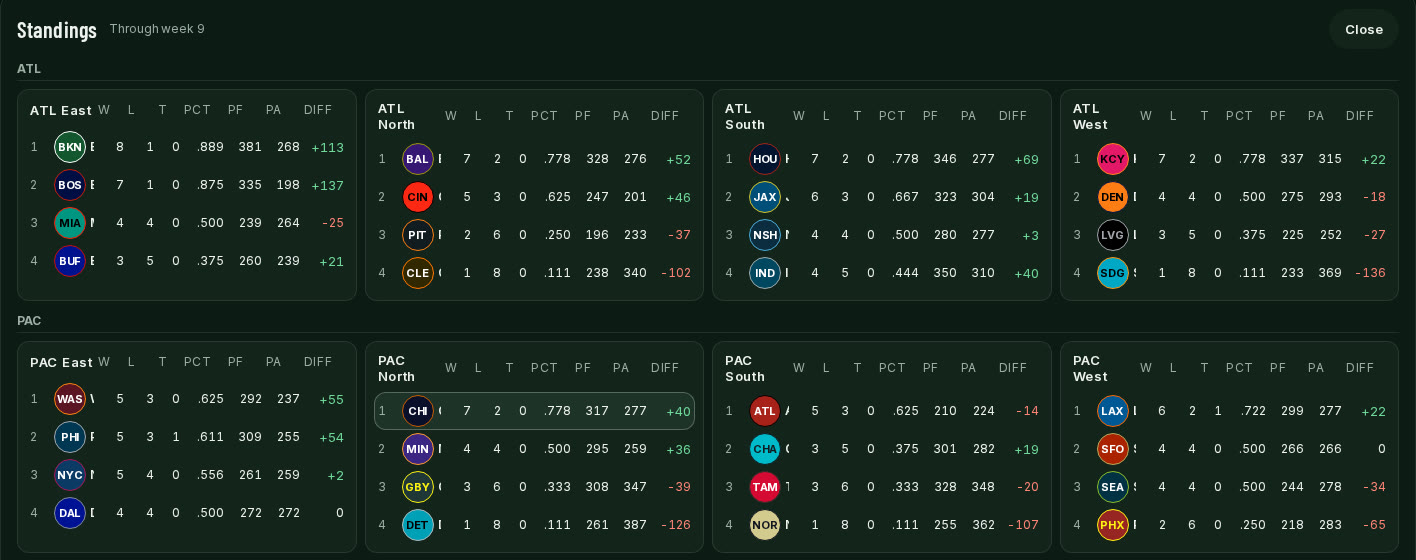
The season
Eighteen weeks, pro tiebreakers, a playoff bracket.
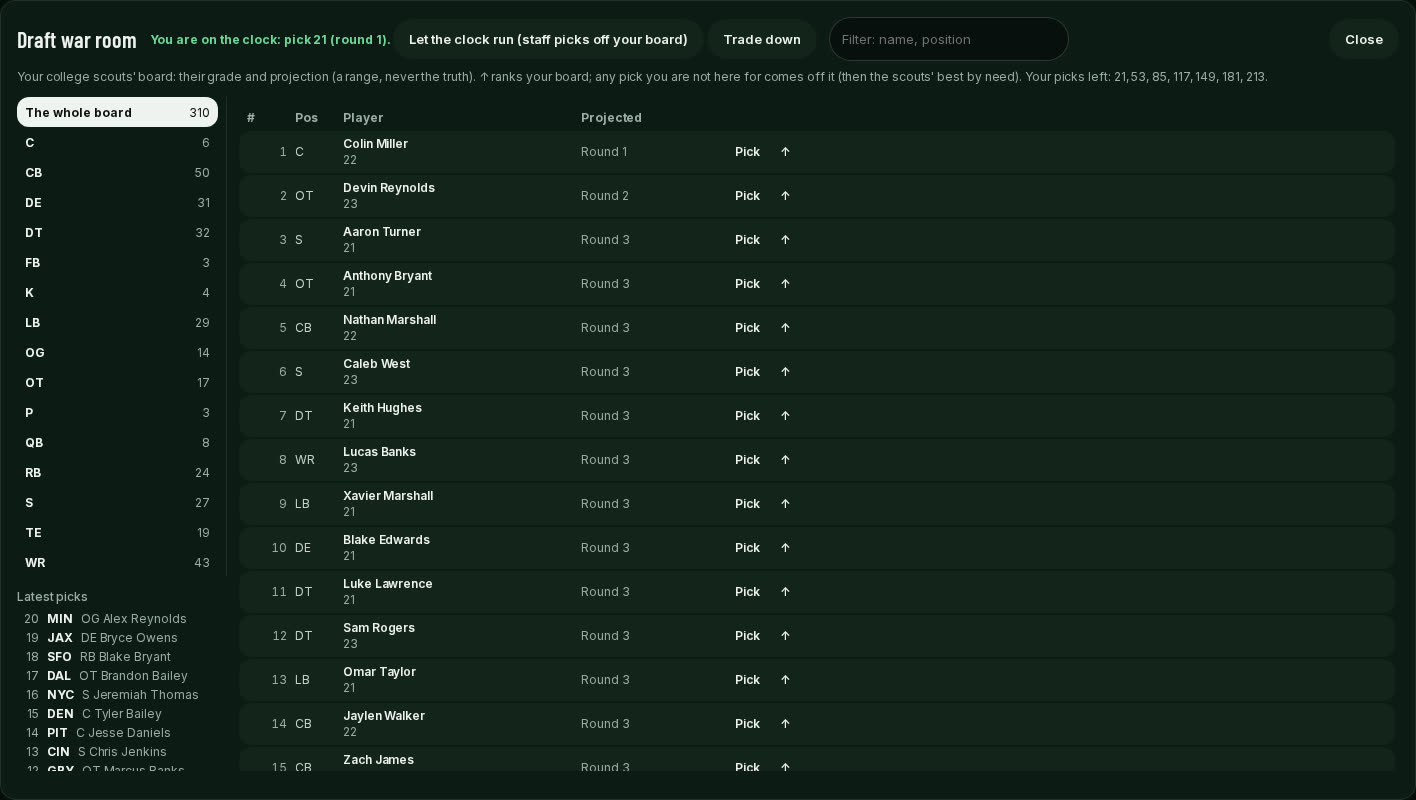
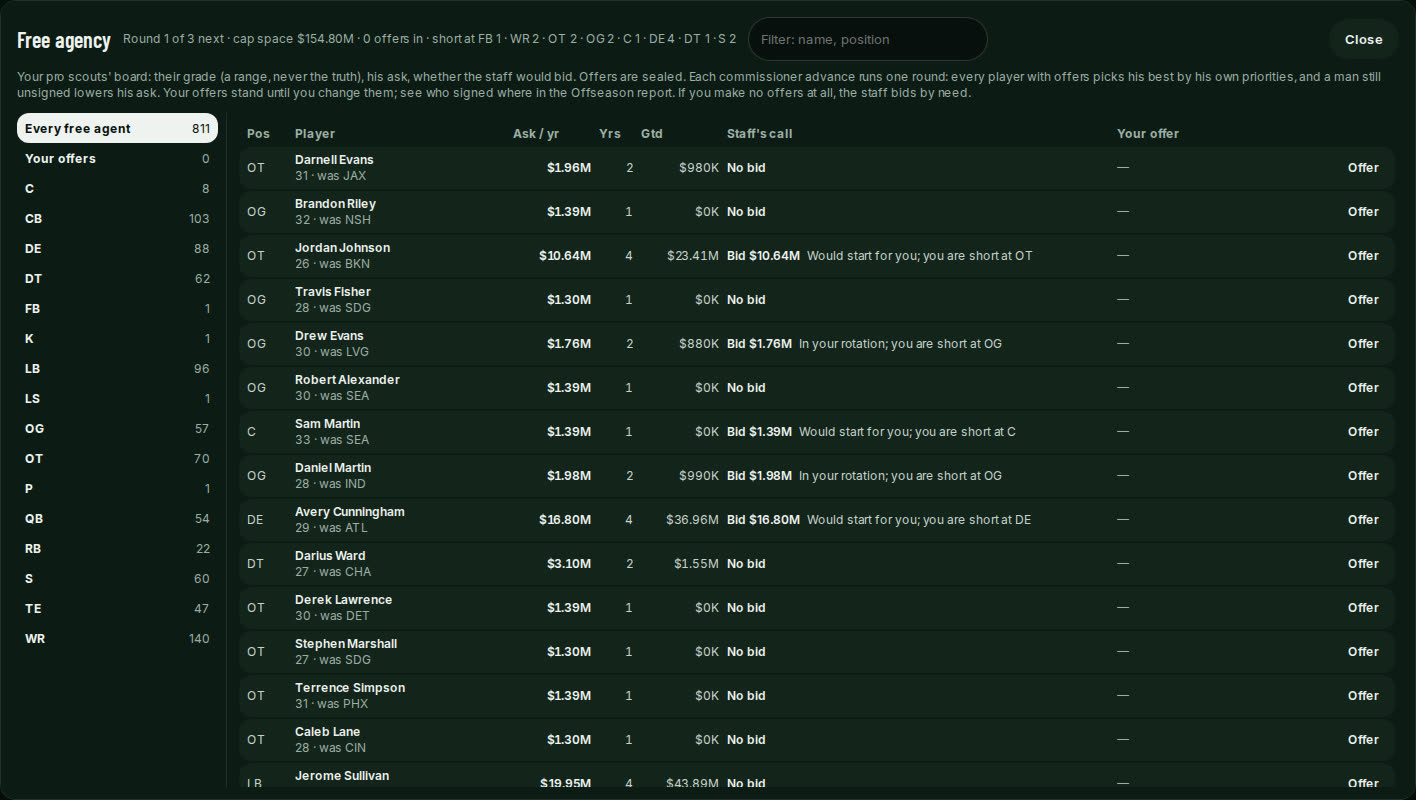
The offseason
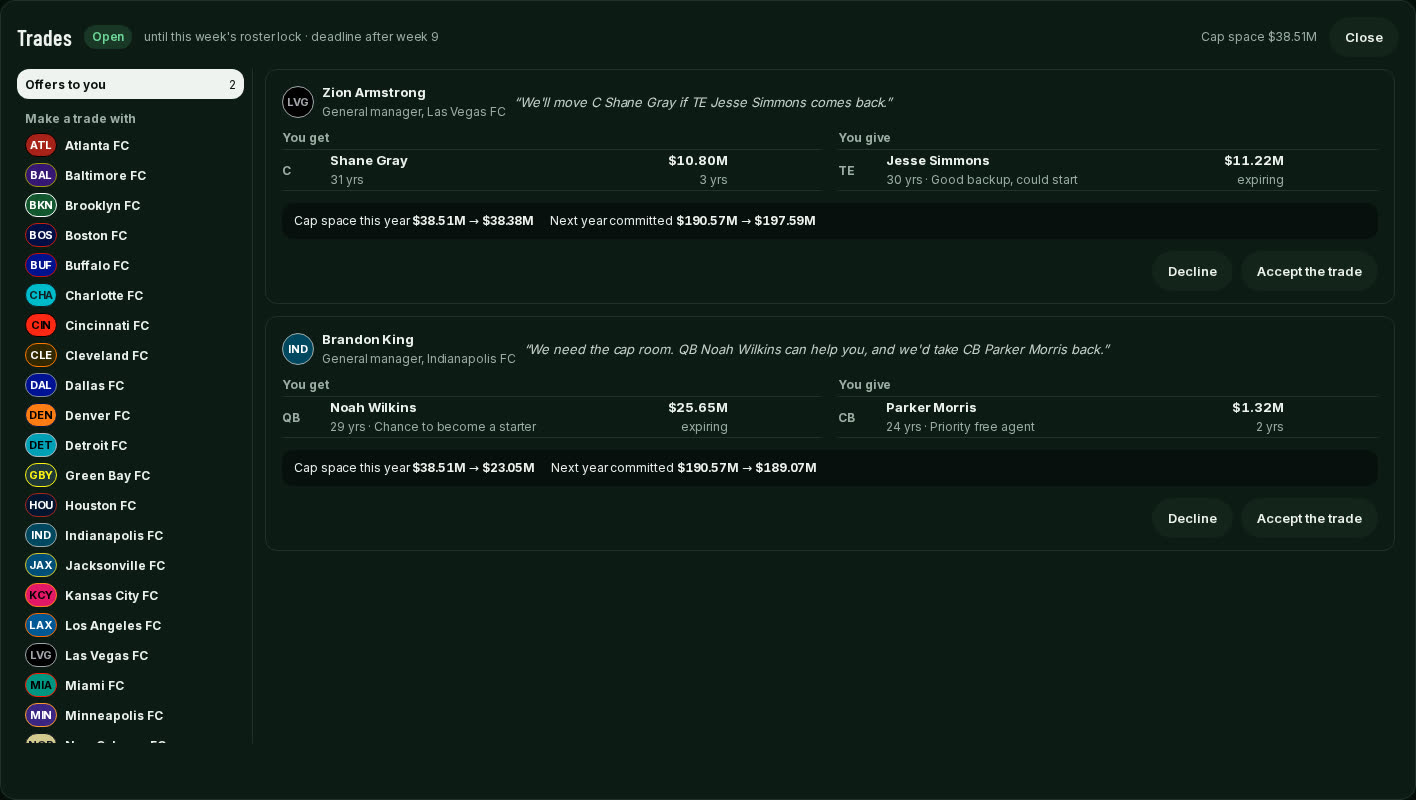
Draft from your scouts' reports, bid in free agency under the salary cap and trade with GMs who each have their own priorities.Draft through the fog. Bid under the cap. Trade with GMs who have angles.
Your league
Join a league run by a commissioner, with changes on the record for all to see. AI GMs run the clubs still waiting for a coach.A commissioner runs the league, changes on the record. AI GMs run the open clubs.